
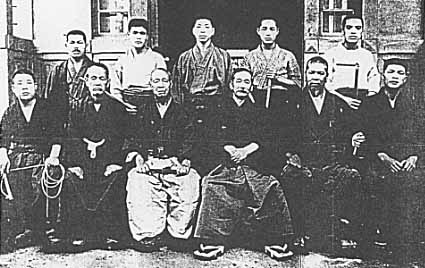
 Judo’s founder, Kano Jigoro Shihan, had a training background in a number of koryu jujutsu traditions, including Tenjin Shinyo-ryu and Kito-ryu. His new martial art of judo was heavily influenced by the principles underpinning these arts.
When Kano Shihan was formulating the kata of Kodokan Judo, he sought input from a range of the top jujutsu masters around Japan. His wish was to codify and synthesise the time- and battle-tested principles contained within these schools at a time when Japan was stepping out of its feudal social structure, embracing modernity and western influence. The survival of samurai traditions was at risk, and Kano wanted to mitigate this. Ryuha headmasters from a range of koryu traditions were invited to form the Judo Kata Seitei-in, contributing techniques from their schools.
Along with Kodokan instructors, were representatives from these ryuha:
- Sekiguchi-ryu
- Takenouchi-ryu
- Fusen-ryu
- Miura-ryu
- Kyushin-ryu
- Yoshin-ryu
- Shiten-ryu
- Takeuchisanto-ryu
- Sosuishi-ryu
Sosuishi-ryu Jujutsu’s 14th Headmaster, Aoyagi Kibei Shihan, attended this summit, which was held in 1905 at the Dai Nippon Butokukai (Greater Japan Martial Virtues Society), Kyoto. He contributed Sosuishi-ryu techniques, the principles of which were incorporated into the expanding Kodokan Judo syllabus. In time, Aoyagi Sensei became a close friend of Kano Shihan. In 1911, Aoyagi started teaching Kodokan Judo at his Seirensha Dojo. At that time, he renamed it the Sekiryukan Dojo, and Judo has been practised here alongside Sosuishi-ryu Jujutsu ever since. Aoyagi was also involved in the expansion of Judo into Korea, with some sources suggesting he introduced Judo to Korea, and taught it in Seoul between 1903 – 1908. Sosuishi-ryu’s 15th Headmaster, Shitama Shusaku Shihan continued his legacy, studying at the Dai Nippon Butokukai and attaining the Judo 8th Dan, as well as holding Menkyo-Kaiden in Sosuishi-ryu Jujutsu. The two arts have been practised side by side at Sekiryukan since 1911, and their presence at Sekiryukan forms an important part of Judo’s expansion and lineage in Southern Japan. The Sekiryukan is one of the oldest Judo dojos in Japan, and today welcomes visiting Judo and Jujutsu students from around the world.